|
|
A New Resort Traces Indonesia's past through
A Collection Of rare cultural artifacts
Set amid rice paddies and lotus ponds in the ancient village
of Canggu on Bali's west coast is Hotel Tugu Bali, the third
hotel project of Anhar Setjadibrata. In ten thatched pavilions,
he realized his vision for a resort that celebrates Indonesia's
history.
For Javanese hotelier Anhar Setjadibrata, collecting antiques
is as much a historical quest as an aesthetic one. "I see each
piece I own as part of the puzzle of Indonesia's past," he says.
"Putting them together to tell a story is my passion." Last
year Setjadibrata translated that passion into new luxury resort
Hotel Tugu Bali on the island's western coast. The twenty-six-suite
hotel tells the story of several hundred years of Indonesian
culture and history. Its artwork meander through different styles
and centuries, pausing to explore Setjadibrata's ancestral Chinese
roots, to showcase his favorite artists an to honor the local
Balinese heroes who fought against the Dutch colonials.
Tugu Bali sprang from the Indonesian antiques and culture artifacts
that Setjadibrata has amassed over the past twenty-six years.
He call it a "museum boutique hotel - a place where drama and
romance and luxury come together to bring the collection to
life." |
He first caught
the collecting bug at the age of twenty-five, he says, when
he made a modest foray into Ming Dynasty furniture, porcelain
and silver. That was followed by purchases of carved wood Madurese
panels, Javanese doors, Balinese stone sculptures and Dutch
colonial architectural artifacts. Later he bought entire buildings,
one of which - the Palace of Harmony - he reconstructed in itsentirety
at Tugu Bali. "In the early 1970s I was struck by the fact that
Indonesians were throwing their culture away," he recalls. "They
didn't recognize its value. Old houses, furniture, photograph,
silver, gold, everywhere you went, people were replacing them
with modern things." Sixteen master craftsmen executed his design
sketches. Composed of ten thatched structures, the resorts,
at first glance, has a distinctly Balinese flavor.
"I realized that my collections must no longer speak only to
me, they must speak to all as a symbol of my country's rich
history and culture heritage." says Setjadibrata, who began
acquiring works in the 1970s. The main pool features lion statues
spouting water.
But the interiors reflect his travels throughout Indonesia as
much as the wanderings of his imagination. The open lobby is
both the centre of the resort and its most majestic building. |
Setjadibrata, who designed the hotel,
used an alang-alang roof to shade the entrances's porte cochere.
At left is a shrine to Bali's Hindu gods.
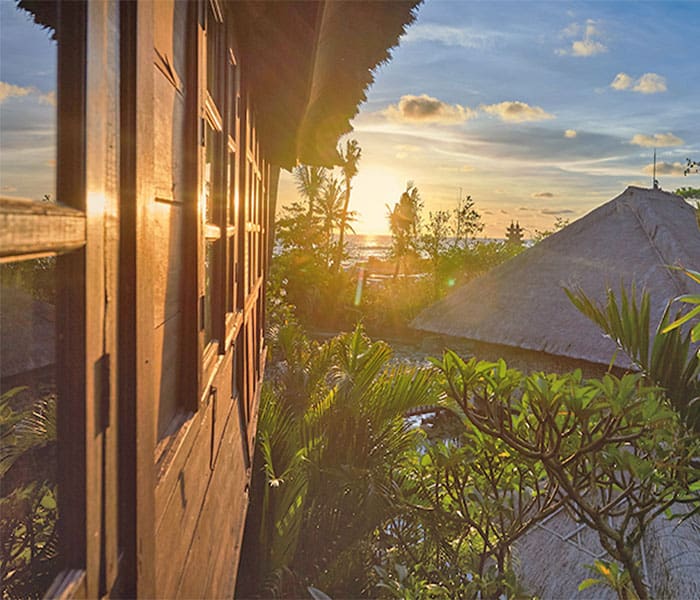
An area off the lobby "faces the beach
and sunset," Setjadibrata says. "It's where we serve tea every
afternoon." "We want our guests to enjoy the hotel's amenities,
but we also hope they become involved in Balinese traditions,"
he says.
|
It's soaring alang-alang roof is supported by twenty-foot-high
wood columns, each topped with the carved head of Boma, a mythological
Balinese guardian whose leering face is believed to scare away
evil spirits. The confluence of styles and traditions that characterizes
the rest of the hotel is evident in the lobby, where his pieces
are on display and also for use by guests. They include a century-old
gamelan set and a sixteenth-century cupu manik, or sacred ceremonial
bowl.
Similary exotic objects spill into the guest suites, two of
which pay homage to painters who nurtured an artistic flowering
in Indonesia in the early twentieth century.
The Le Mayeur suite, with private swimming pool and dining pavilion,
is named for Adrien Jean Le Mayeur de Merpres, the late Belgian
artist who moved to the island in 1932, married Ni Polok, a
renowned Legong dancer, and created a legacy of paintings depicting
everyday Balinese life.
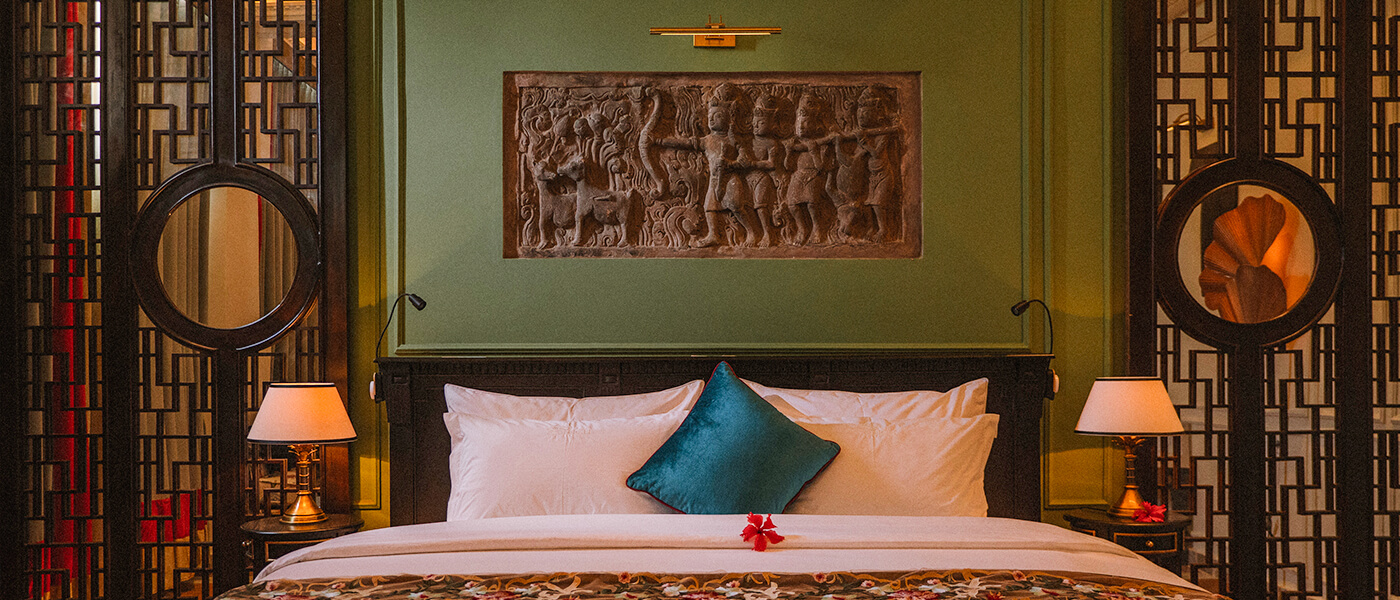
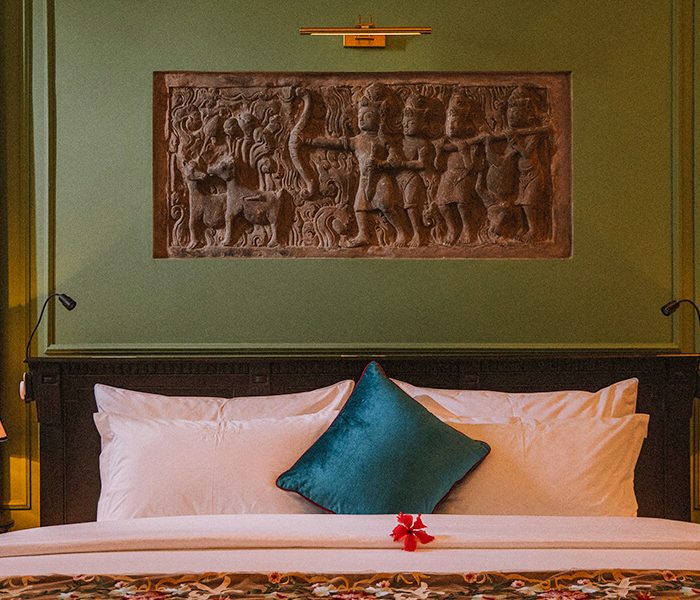
The villa is furnished with a canopied four-poster made from
antique Balinese pillars and matching side tables and chest,
carved by a blind woodworker in the couple's employ. Personal
effects, such as Ni Polok's loom and several portraits of the
couple, are scattered around the suite. "Most of all, I wanted
the room to capture the spirit of how they lived," he says.
Tugu Bali also honors Walter Spies, the influential German musician
and painter who made Indonesia his home from 1924 until his
death in 1942. Spies cofounded Pita Maha, an art association
that helped to foster a resurgence in traditional painting.
"What few Indonesians remember is that before moving to Bali,
Spies lived at Prince Djojodipuro's palace in Yogyakarta," Setjadibrata
says. The Walter Spies Pavilion highlights that period, borrowing
from the hybrid architectural style typical of the ancient Javanese
city in the 1920s. Constructed of brick and timber, it incorporates
several original Dutch Colonial architectural elements, including
the entrance gate, door railings and stained-glass windows,
that Setjadibrata salvaged from Spies's residence.
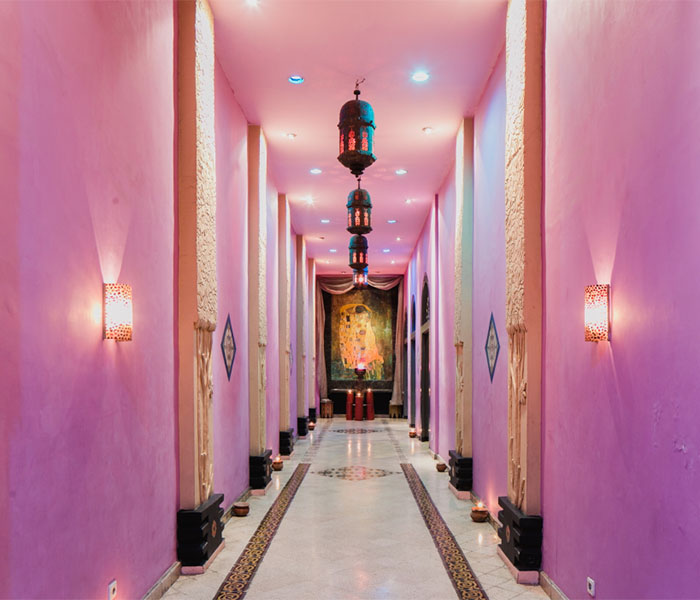
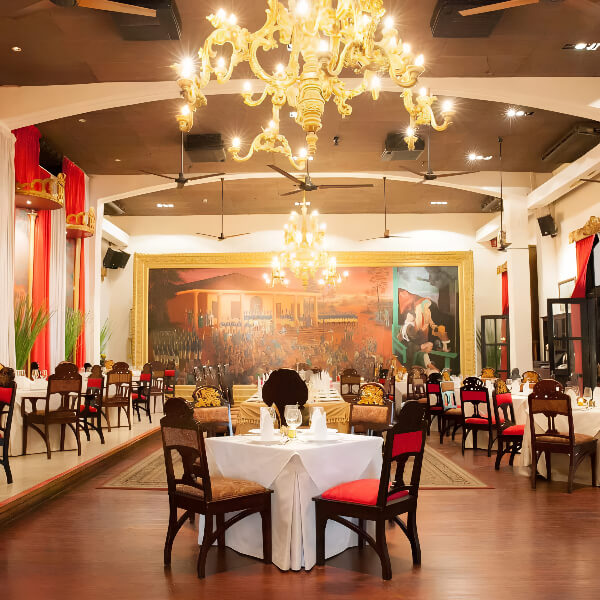
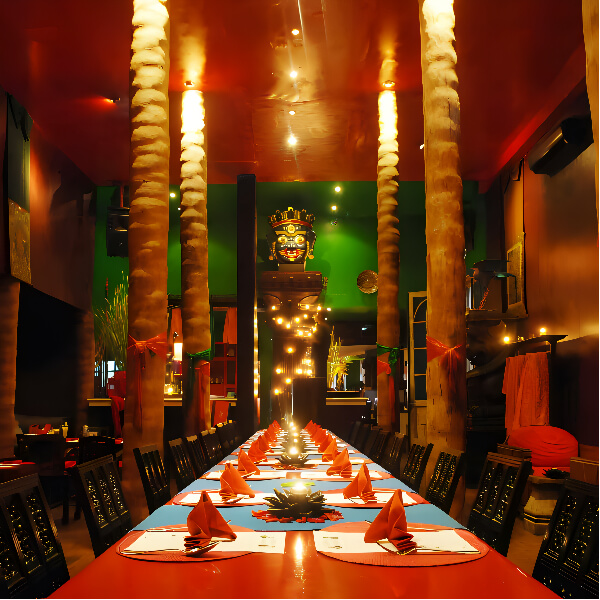
The Palace of Harmony is an eighteenth-century Peranakan ancestral
hall that speaks to Setjadibratas own Indo-Chinese roots. He
rescued it from destruction and turned it into a dynamic environment
for dining. Against a back drop of crimsons and yellows, vintage
photographs, antique silk textiles and Chinese-style teak tables,
chairs and cabinets mingle with life-size stone sculptures of
Chinese deities.

Tugu Bali is the culmination of Setjadibrata's lifelong fascination
with Bali. Part history lesson and part romantic getaway, it's
his version of paradise. "Almost everything in the hotel is
related to the island in one way or another." He says. "I'd
like to think that I brought a piece of its culture back to
life.
|
|
| |
|
|
|
Unique Luxury resorts featuring exclusive
collection of historic Indonesian art & cultural artifacts.
Complimenting sun, sand and sea...
Accomodation on Bali keeps re-inventing itself. A demanding
in-bound market has prompted hoteliers to look beyond the obvious
"tropical" concepts to more enriching cultural inns and retreats.
While the predominate travel market on Bali will always be those
requiring the best of amenities which are synonymous with leading
beach resorts, a new breed of hotel entrepreneurs are responding
to growing segment who are demanding less.
Imagine, guest ....
who actually demand less? Altough, these same travelers are
also needing diversions to replace those that come with opulent
resort stays. Today this emerging market is, in part, in search
of hidden places they are not required to share with the bulk
of humanity, yet milieus that are truly representative of the
environment and local people. One of these rarefied locations
is the newly-opened Tugu Park villas on Bali's secluded Canggu
beach. In this issue , travel writer Nigel Simmonds discovers
the culturally-rich pleasures of Tugu Park, which are more like
that of visitinng a museum than staying within a resort, he
finds. |
From
a retro look at Bali's golden age of painters and artists back
further to the more elaborate early Balinese heritage, Tugu
Park's man-with-a-mission, Mr. Anhar Setjadibrata,
has stuck to his "commitment to keep the past alive. "His one-of-a-kind
property, like its sister hotel in Malang, East Java, will no
doubt add greater appeal to the area and mark a milestone in
luxury properties which are purely Indonesian inspired.
The other phenomenon on this "morning of the world" island is
the steadfast succes of the spa business. Bali has elevated
itself, in only a matter of several years, as one of the world's
leading spa destinations. However, the succes of preventive
health care has not been solely due to foreign expertise and
large amounts of capital investment. (Allow me to correct myself,
the spa market has taken more than several years to develop).
The Balinese attitude towards naturopathic health practises
is age-old, a tradition that has been handed down from generation-to-generation.
In such a demanding and competitive travel market, it's reassuring
to know that the ever-changing Bali "experience" continues to
rely on characteristics that have always been part of the local
fabric.
Rudy Akili/President Director-Smailing Tour &
Travel
|
|
| |
|
|
|
|
|
Ever dream of an island at
the most remote corner of the earth, where you can finally
be alone (together)? Try the mysterious trop in Bali
or the unspoiled nature in the Maldives. Now boarding…
By Katia KULAWICK and Marie FAURE
BALI
In the hearth of the Indonesian archipelago, the Island
of the Gods is a Shangri-la of black sandy beaches,
volcanoes, temples and rice paddies. The average annual
temperature is 26°C (79°F), but the best time
of year is between April and November. Flights into
Denpasar.
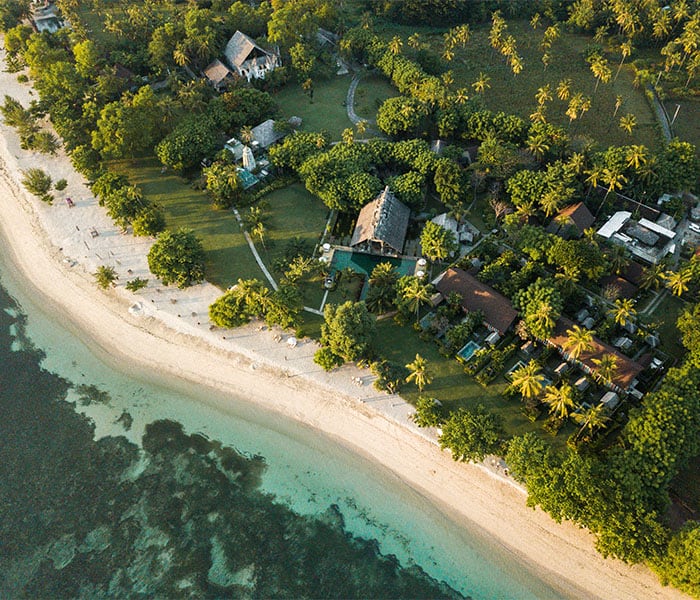
PLACE TO BE The Tugu (above) is a timeless
hotel on a black sandy beach on Bali’s west coast.
Dreamed up by a Javanese collector, the Tugu is a tribute
to Indonesian art: exotic wood, Japanese-style garden,
tropical swimming pool and stone sculptures. The wedding
suite Puri Le Mayeur, in the middle of a lotus pond,
is an absolute must-see: 250 m² (2,500 sq.ft) of
absolute luxury, with a privateswimming pool, antiques,
indoor-outdoor bathroom… and a floating pavilion
for having breakfast surrounded by lily pads.
From 440€ per night.
www.tuguhotels.com |
|
|
|
|
|
Between ...
rice fields and Canggu Beach, Bali, the boutique museum concept
of a resort hotel becomes a reflection of Indonesian culture
and history.
A desire to remind people of Indonesia's rich culture, inspired
Anhar Setjadibrata - an Indonesian antique art collector - to
build a hotel in a boutique museum resort concept. A perfect
place to display his collection. The location in desa Banjar
Canggu (between Canggu Beach, rice fields, and the sacred Batu
Bolong Temple) also supports the hotel's cultural concept.
Inspired By Balinese Legends.
The legendary Tirta Empul (sacred healing water) of Batu Bolong
Temple became an inspiration to create waterpools around the
hotel buildings. While other Balinese legends inspire the different
interior elements in 26 guestrooms, and two special designed
suites. These suites are dedicated to the memory of famous painters
Jean Le Mayeur de Merpres and Walter Spies, and inspired by
their rooms. With typical Balinese alangalang roof and building
form, the hotels lay out conforms more to the collection display
arrangement. |
Emphasize
On Local Culture.
Throughout the hotel guests will sense a strong Balinese atmosphere.
Starting with a tugu (monument) — The hotel's symbol — made
out of a 200 year old hollowed tree trunk well structure placed
in front of the main building. And also a 700 year old Reco
Pentung statue from Blitar in front of the Bale Agung (main
dining area).
The hotel includes an exclusive gallery filled with historical
antique treasures, among other a Cupu Manik (a holy water bowl)
that started Anhar's historical art collection. The Bale Sutra
{The Palace of Harmony) restaurant is an ancient temple structure
(1706) transported from East Java, and the Bale Puputan—decorated
by photographs of Balinese kings — is a small conference room
with an antique Dutch marble table.
Bayung Gede Tradition.
Focused on historic and artistic values, a large part of the
hotel concept is inspired by the Bayung Gede village culture
of Kintamani. The guests sleep in rooms designed like traditional
houses, enjoy the Wantilan Agung lobby built like a village
pendopo — with Boma head carvings on the columns to ward off
evil, and experience a traditional megibung style banquet in
the Bale Agung. All of this in the unique Bayung Gede tradition.
The diverse Indonesian culture, rich with historic values from
the past, can be a source of inspiration to create a unique
hotel concept. A point proven by this charming boutique museum
resort hotel that strongly reflects parts of Indonesian culture.
LOCATION : Hotel Tugu Bali. Banjar Canggu. BALI.
INTERIOR PHOTOGRAPH : Ibham Jasin.
EXTERIOR PHOTOGRAPH: Oki Soetrisno.
VISUALITATOR: ERN, RBS.
Extract from Laras Magazine issue # 104 August 1997. Page 25.
|
|
|