|
|
|
|
| |
|
|
| |
|
|
|
| |
|
|
|
| |
|
|
|
| |
|
|
|
|
|
|
|
|
|
|
RESTAURANT AND LIVING MUSEUM |
|
|
Dapur Babah Elite is much more than merely a restaurant, it is a living museum
that celebrates 'Babah' culture, the culture of the distinct group that emerged in
the colonial era as result of marriages between Chinese migrants who settled in Java and
the local women they took for their wives. While the newcomers retained elements of the culture of their ancestral homeland, they adapted to their local surroundings.

|
|
|
|
|
|
While most of these migrants began their journey as poor coolies, they often worked hard and prospered in their new homeland, often playing a significant role as traders in the colonial economy. With the stratified nature of colonial society, they occupied a distinct place, differentiated clearly from both native and Dutch society and acting as middlemen between the two groups.
With extremely few women migrants arriving from China, it was natural for prosperous migrants to take at least one local wife, and often many concubines. While their husbands may have ruled the roost in the marketplaces and business centres, it was the women who controlled the kitchens. Using local ingredients, the nyai, as these women were known, worked with their house cooks and maids to adapt local dishes to the tastes of their husbands to create a fusion of styles that often incorporated elements of the culture of the ruling caste, the Dutch colonial elite. While the influence of each element varied according to location and the status of the individual families, the style that emerged was clearly distinct from that of any of the influences from which it emerged. |
|
|
|
|
While the peranakan cultures of Singapore and Malaysia are well known, with the suppression of Chinese culture under the New Order regime, that of Java has been neglected. While the cui sin e may survive in private homes or as an unacknowledged influence in restaurants around the island, Dapur Babah is the only restaurant where this style of cuisine is explicitly celebrated, with dishes such as Babah friend rice, Fuyonghai tofu, lodeh kacang tolo and cecek and macaroni cake and potato croquette with taoco sauce.
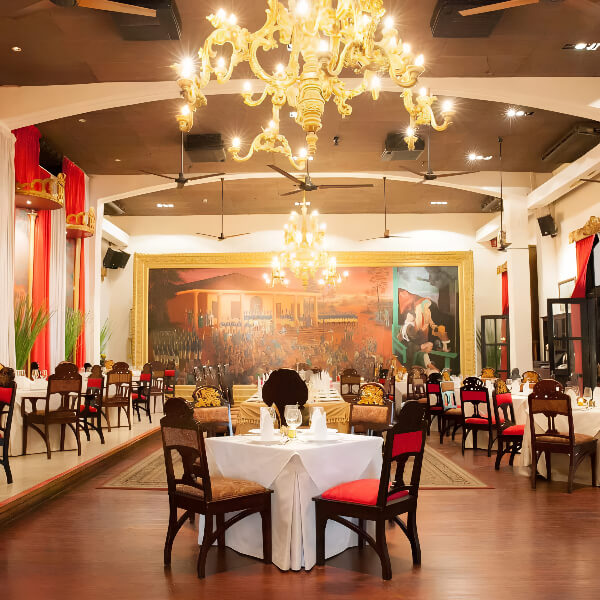
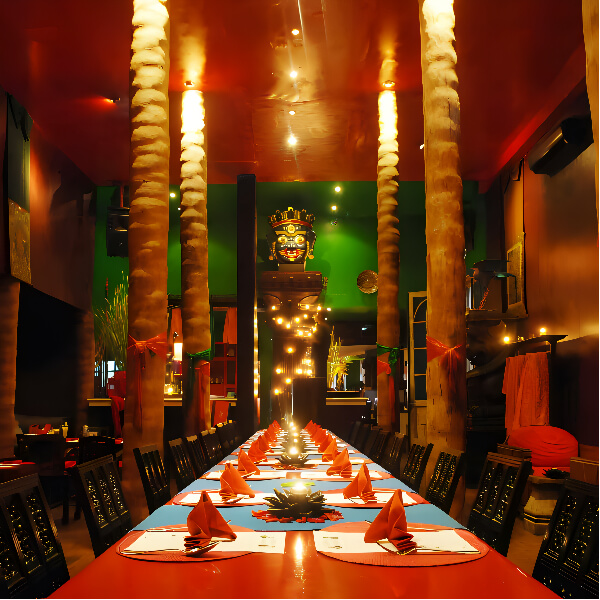
However, the Babah culture involved much more than cuisine. Architectural styles, artistic tastes, clothing and the decorative arts were all influenced by the blending of the various cultures. All of these aspects of the culture are celebrated at Dapur Babah, which is elegantly decorated with photos of prominent Babah families, some fabulously wealthy, such as the powerful sugar baron Oei Tiong Ham and many other artifacts of the colonial period, such as a bulky VOC emblem from the I 7Th century and a room separator from the Ming dynasty. At the back of the establishment is a semi-open terrace, inspired by the kitchen of the Babah Oei family, with a statue of a kitchen goddess, old Chinese glass lanterns and other kitchen utensils from the period. |
|
| |
|
|
While the proprietor, Anhar Setjadibrata, is often described as a passionate collector of antiques, it might be more accurate to describe him as a collector of stories and tales. For him, the items he collects are worthless unless they talk to the people who view them. When asked whether some of these items should perhaps be displayed in a museum, he demurs. "When people visit a museum, they feel like they are in a boring history lesson at school. I want my guests to relax and enjoy the beauty of these objects the way they were meant to be enjoyed, not to look at them in a sterile environment in a glass case," he says.
For Anhar, the people of Jakarta have much to learn from their past. While he looks back at the history of the city with pride, saying that in the colonial era it was one of most beautiful and well-laid out cities of south-east Asia, attracting great artists from Europe and Asia to cultural events that were discussed with respect across the world, he is less happy when he |
|
|
looks at its present. "There is very little attempt to preserve our heritage. A nouveau riche mentality prevails, according to which anything modern or foreign is good, and our own culture is inferior," he says with a sigh, adding that while foreign visitors delight in the Dapur Babah, many high level bureaucrats have reacted with contempt, wondering why anyone would bother opening a restaurant filled with 'old things' and offering 'the type of food you can buy in a warung'.
|
|
|
|
|
|
Similarly, he says that little attempt has been made to preserve or retain the character of Jakarta's most significant heritage zones. He deliberately chose the site of his restaurant for its historical significance: in the Dutch era, Jalan Veteran was one of Batavia's most fashionable streets, with most of its buildings owned by a rich sheikh from Yemen. Now, it has been allowed to decay and fall into a decline-these days, fashionable Jakarta prefers the latest shopping malls, switching from one to another as the season's change.
Anhar would like to see areas such as Jalan Veteran and the areas around Taman Fatahillah in Kota set aside as heritage zones, where Jakarta's residents and tourists could walk at their ease in pedestrian zones, enjoying an open air concert and dining and drinking in establishments that preserve the character of old Batavia while offering the finest and best of the present at the same time. He is diffident when he describes this vision, however, saying that he has found little support from the city's developers, who prefer the quick profits to be reaped from the development of yet another soulless venue on a location without a history or past.
While Anhar's dream may be a long way from fulfillment, Dapur Babah is already a wonderful resource for those who are searching for a dining venue that offers much more than food and drink. Rather, it is a place where residents and visitors to the city can relax and enjoy history, rather than forcing themselves to study it.
Dapur Babah élite
Jl Veteran I / 18, Jakarta Pusat 10110
Tel: +62 (21) 385 5653, Fax: +62 (21) 385 3040
dapurbabah@tuguhotels.com
www.tuguhotels.com |
|
| |
|
|
|
| |
|
|
|
| |
|
|
|
|
| |
|
|
|